

Successful inspection technology firm USA Borescopes has unveiled a new generation of advanced nuclear borescopes, designed to drastically minimize radiation exposure for nuclear and industrial inspectors through remote visual inspections that enhance worker safety, reduce operational downtime, and set new benchmarks in regulatory compliance.
In every nuclear power facility, we cannot emphasize enough just how paramount radiological safety is. Stringent regulations set by organizations like the US Nuclear Regulatory Commission cap annual worker exposure, currently set at 5 rem or 0.05 sieverts per year, to levels well below those shown to cause measurable health effects. Despite these safeguards and routine accident-free operations in the vast majority of plants worldwide, the use of sophisticated remote-enabled inspection devices is invaluable to achieve the principle of ALARA, “as low as reasonably achievable.”
The importance of minimizing personal exposure became clearly obvious in the aftermath of significant plant incidents and doesn’t just drive the implementation of comprehensive shielding and personal dosimetry programs, but also a continuous search for engineering solutions that reduce or even eliminate the need for physical entry into high radiation areas. With that in mind the nuclear inspection camera come to the front focus for mitigation.
The Case for Remote Visual Inspection

Routine inspection activities, whether in power plants, petrochemical refineries, or defense installations, have historically been a leading cause of cumulative radiation exposure for maintenance and engineering staff.
Even for planned outages or tightly scheduled maintenance windows, the act of visually verifying pipe, vessel, or reactor internals sometimes required donning thick protective gear and racing against the clock to minimize exposure. Each extra minute and each unforeseen complication directly translates into a greater risk.
Modern remote visual inspection (RVI) tools, such as an advanced radiation borescope or videoscopes, now allow staff to perform critical diagnostic and documentation tasks from a safe distance, sometimes even from outside primary containment or high-radiation zones. By harnessing optics, robotics, and digital imaging, these compact and portable devices represent a technological quantum leap over previous generations of endoscopes and rigid tube cameras.
How Borescopes Are Engineered for Harsh Environments
To perform reliably in radioactive environments, a specialized radiation borescope must possess a set of technical characteristics:
Radiation resistance
The insertion tube and the camera head are constructed of materials highly resistant to cumulative radiation doses. For instance, leading borescope models withstand exposures up to 1,400 gray (or 140,000 times the annual human exposure limit) thanks to advanced alloys and LED illumination tips that do not degrade like traditional fiber optics. With this data in mind, power plant borescopes are essential to minimize exposure.
Length and flexibility
Inspection areas can be deep within reactor vessels, primary coolant pipes, or behind thick biological shielding. Borescopes with insertion tubes up to 30 meters (almost 100 feet) in length and highly maneuverable, articulating tips allow for detailed navigation in complex geometries.
Image quality
Modern systems integrate high-resolution imaging sensors, powerful LED lighting, image contrast processing, and optional tip adapters for wide or zoomed fields of view. This ensures defect detection, such as corrosion, cracks, or insulation faults, is possible even in dark, confined, and highly reflective conditions.
On-site maintainability
Replaceable and sacrificial insertion tubes ensure that even if a component becomes contaminated beyond decontamination, downtime and equipment costs are minimized. Many of the powerplant borescopes and long length borescopes that are available offer interchangeable probes. In the event that the borescope probe has been exposed to a ‘hot’
User-friendly features to ensure safety and productivity
Gravity sensing automatically orients live images on screen to prevent confusion and expedite the inspection process.
Integrated keypad articulation lets the inspector manipulate the borescope remotely with great precision.
Easy data documentation, including onboard video and image capture, storage, and remote collaboration functions, ensures inspection records meet all regulatory and reporting requirements.
Application in a Nuclear Plant
Within the nuclear sector, routine component inspection is not just a procedural requirement but is central to operational licensing, plant longevity, and public safety.
Every inspection is governed by a stringent framework of international standards, such as the ASME Boiler and Pressure Vessel Code (BPVC) Section XI, and observable lessons learned from past industry events. Many of these inspection systems require an articulating borescope probe with lengths up to 100 feet. The Vuman E3 is the choice inspection tool for many nuclear inspectors.

These inspections, implemented at regular intervals, are critical for identifying early signs of wear and tear or failure that could compromise reactor integrity or safety systems. Key targets of inspection include:
Reactor pressure vessels (RPVs)
Reactor pressure vessels form the very heart of every nuclear power plant, housing the nuclear fuel, control rods, and coolant.
Inspections focus on detecting cracks, corrosion, and weld defects that are often invisible to the naked eye but could turn into a catastrophic failure if left unchecked.
Modern methodologies employ a combination of advanced phased-array ultrasonic testing (UT), eddy current testing, and visual inspection by high-resolution borescopes.
Fuel assemblies and control rod mechanisms
The geometry and mechanical integrity of nuclear fuel assemblies and control rod drives are vital to sustain controlled fission without warping, bowing, or mechanical interference.
Periodic inspections utilize articulating borescopes and videoscopes to visually confirm precise alignment and look for signs of vibration wear, foreign object intrusion, weld cracking, and corrosion products.
Some systems leverage advanced optics and measurements calibrated against as-built dimensional records, ensuring even subtle deformation is caught at the very early stage. Inspection also helps confirm the full withdrawal and insertion travel of control rods.
Steam generators, heat exchangers, and primary/secondary coolant loops
These heat transfer systems are vital for safe reactor operation and energy efficiency, as well as serving as containment boundaries. Inspections target internal tube surfaces for blockages, fouling such as sludge or scale buildup, tube wall thinning, cracks, and leaks. All of these could threaten thermal efficiency or allow radioactive materials to escape from the primary to the secondary system.
Borescopic examination, combined with advanced UT, remotely guided tubes, and sample extraction, spots early indicators of corrosion or chemical attack before leaks develop. This inspection also require a long length borescope and globally the borescope camera that is chosen is the Vizaar Vuman E3 E3+.
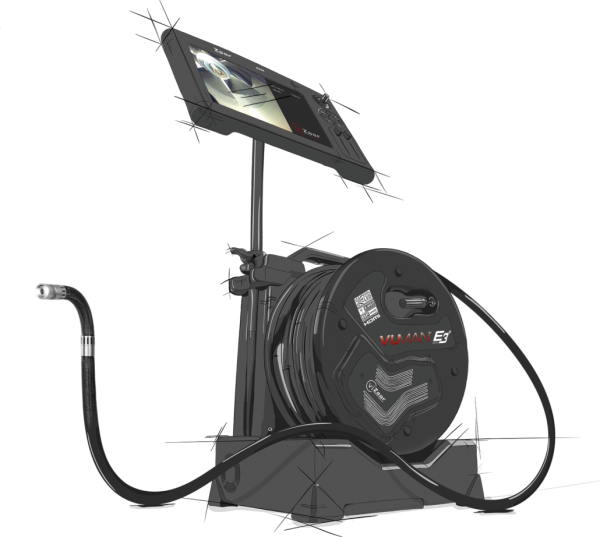
Videoscopes contract long complex piping routes and are relied upon by operators due to their long insertion lengths, high-powered illumination, and articulation to reach deep into systems without unnecessary system disassembly.
Containment structures
Biological shielding and secondary containment boundaries are the last line of protection between radioactive substances and the working environment and community.
Inspections focus on liner plates, moisture intrusion, and cracking within concrete or steel liners, as well as penetration seal integrity.
Technicians can use specialized borescopes and robotic systems to assess wall and liner conditions, verify isolation capability, and confirm the absence of unmonitored leakage paths in a non-invasive manner. Advanced digital imaging and mapping enable a permanent, auditable record for regulatory compliance and long-term trend analysis.
Regulatory and Safety Benefits
Inspection documentation and validation are critical, not just for plant safety but also for licensing and compliance.
High-quality images and video acquired during a remote inspection form part of the permanent records, backup claims of preventative maintenance, and support the case for license renewal with regulatory authorities.
Through remote documentation, plants can strengthen their position in audits.
Why USA Borescopes Is Your Trusted Partner in High-Reliability Inspection

USA Borescopes is at the forefront of RVI technology, supply, and claims, with a broad, expertly curated range of inspection solutions tailored to the demanding environments and unique challenges of modern industry.
Comprehensive equipment
USA Borescopes delivers videoscopes, fiberscopes, endoscopes, and pipe inspection cameras across a wide spectrum of diameters, insertion lengths, and imaging resolutions, meeting the precise needs of nuclear, oil and gas, chemical, and aerospace clients. This diversity of equipment ensures that teams can source the right tools for each task.
Safe and explosion-proof units
For environments with the risk of fire, explosion, or hazardous gas exposure, USA Borescopes provides instruments with ATEX, IECEx, and Class 1 Div 2 Borescope certifications.
These models are rigorously tested to prevent ignition, making them essential for inspections in locations as diverse as refineries, chemical plants, and grain processing facilities.
World-Class Technical Support

USA Borescopes’ technical specialists guide clients through every step, from risk assessment, equipment selection, customization, operation, and ongoing maintenance.
With expert recommendations tailored to clients’ unique site requirements and compliance standards, optimal results are ensured.
Flexible procurement strategies
Acknowledging the dynamic nature of industrial inspection, USA Borescopes offers rental, lease, and purchase options with or without financing.
Short-term rentals support emergency response or specialized one-off projects, while leasing programs allow clients to access the latest technology without long-term commitment.
This flexibility means organizations can adapt quickly to the evolving challenges of inspection requirements without compromising on cost.
On-demand accessories and upgrades
USA Borescopes provides interchangeable tip adapters, cleaning kits, spare insertion tubes, high-durability carrying cases, and advanced imaging software solutions. Rapid replacement by means of our ‘repair exchange’ process and upgrade options mean critical inspections continue uninterrupted, even if a component is damaged or contaminated.
A Commitment to Innovation and Reliability
USA Borescopes invests in the development and sourcing of state-of-the-art visual inspection products. USA Borescopes’ offerings remain at the cutting edge of safety, compliance, and operational excellence.
USA Borescopes: Safer, Faster, and Smarter Solutions to Minimize Radiation Exposure
Advanced borescope technology stands out as the clearest path to minimizing radiation exposure in hazardous industries. Operators can meet regulatory requirements, reduce inspection costs, and foster a culture of continuous improvement in worker health and operational reliability. It’s all about partnering with USA Borescopes for your site’s most pressing challenges.
Press enquiries can be directed to Joshua Wood in USA Borescopes’ Clarksville office on (931) 362-3304 (or (912) 480-4960 for Español), or you can email Joshua@usaborescopes.com